Maximum sentences for some terror offences too low in the UK?

In an interview with the Press Association the UK’s Independent Reviewer of Terrorism Legislation, Max Hill QC, has said the maximum sentence for some of the UK’s terrorism offences may be too low. In saying this the example he gave was section 38B Terrorism Act 2000, which is an offence linked to an investigation as an expert witness I am currently assisting the police with.

Section 38B is an offence where a person does not inform the police when they believe someone is preparing acts of terrorism. The section applies where a person has information they know or believe might be of material assistance in preventing another person committing an act of terrorism or in securing the apprehension, prosecution or conviction of a person in the UK of an offence involving the commission, preparation or instigation of an act of terrorism (section 38B(1) Terrorism Act 2000). The offence is committed where the person does not disclose the information as soon as reasonably practicable (section 38B(2) Terrorism Act 2000). Proceedings for this offence can be treated as having been committed in any place where the person to be charged is or has at any time since he first knew or believed that the information might be of material assistance (section 38B(6) Terrorism Act 2000).

I have emphasised the term ‘believe’ as this widens the capability of the offence being committed. Just having a hunch that something is not right might be insufficient for a prosecution to succeed in relation to section 38B. For a successful prosecution there will have to be evidence the person charged actually had knowledge that an act of terrorism is being planned or prepared by another.

As Max Hill says, this is not about introducing further terrorism related legislation, it is about allowing the judiciary wider sentencing capability where evidence relating to acts of terrorism is present. As he points out, in the UK there are wider criminal offences related to firearms, knives, assaults and violence against persons that can be applied to acts of terrorism, but if it is proved to be terrorist related activity, this will be a sentencing factor the judiciary can apply. We have seen this in the UK in the murder trials of Lee Rigby and Jo Cox, where the respective defendants were tried for murder with terrorism being a sentencing factor that increased the minimum sentence they had to serve on being found guilty.

I agree with Max Hill, for offences like section 38B the maximum sentence is too low. This offence is likely to be triggered during an investigation following a terrorist attack victims have been killed or seriously injured. Along with the tragic results of terrorist attacks, the high volume of work investigators put into gathering evidence related to this offence does not justify the relatively light sentence a defendant can receive following conviction. I understand that for the police and the Crown Prosecution Service it is the successful conviction it is not the length of sentence that is of concern just the successful prosecution, but this is a maximum sentence and with other sentencing tariff issues that could be taken into account the sentence could be a lot lower that 5 years. I agree with Max Hill’s recommendation that a list or a schedule be provided to assist the judiciary which non-terrorist offences that may considered to have the terrorism aggravating factor considered in sentencing  defendant, with, maybe a consideration of amending some offences with a higher sentence.
Police confirm attack outside Buckingham Palace is a terrorist investigation

The attack by a male armed with a sword on three UK police officers close to Buckingham Palace just after half past eight yesterday evening has been confirmed by the Metropolitan Police to be a terrorist investigation. A 26 year old male from Luton, Bedfordshire was arrested after being retrained with the use of CS gas by police officers after he injured three police officers who, thankfully were not seriously injured.

While we have seen a number of incidents in Europe where attacks have taken place targeting civilians in public places over the last couple of years, the last being in Barcelona in August  this is not the first time in 2017 that police officers or the military have been targeted by terrorists. In April 2017 a male attacked a police bus parked up in the Champs-Elysees with an automatic weapon killing one officer and injuring two others. On the 9th August 2017 six French soldiers were inured in Paris when a vehicle was driven at speed into them and then drove off (with the suspected driver later stopped and shot on a motorway in northern France). Both of these incidents are  believed to have been terrorist attacks.

With the attacks on civilians carried out by Islamic State inspired terrorists who targeted what is termed as ‘soft targets’ such as restaurants, bars/pubs, theatres and other public venues, the military and the police are perceived as hard targets. What have seen in the likes of the attacks in London yesterday and the two mentioned above in Paris, the type of attack has been relatively easy to carry out and lacks sophistication. Along with other public venues or events likely to be targeted,  we are also likely to see similar types of attacks on the police and military in Europe in the coming years. In continental Europe as the police are routinely armed, such attacks will no doubt result in the attacker being killed as we saw with the two Paris attacks on the police and the military, but in Britain 93% of the police officers are not armed. As we have seen following the recent UK terrorist attacks, no doubt the attack outside Buckingham Palace will once more raise the question if more British police officer should be routinely armed. Being a retired English police officer who was proud of the fact that the vast majority of British police officers were not armed because they policed by consent of the public, even I am reluctantly coming to the conclusion that where officers are posted to locations identified as being a high risk of a terrorist attack should be armed in order to save their own lives. If the Metropolitan Police’s Constable Keith Palmer was armed when he tackled with the terrorist who drove into people on Westminster Bridge and then tried to enter the palace of Westminster that contains the UK’s Parliament, it might have saved his life.

It appears that the former UK security service (MI5) director, Lord Evans, is right and we will have to expect a number of these attacks in the coming years. This is of great concern and the question remains as to how  to stop individuals who are inspired by any form of an extremist narrative from carrying out an attack b driving a vehicle into a crowd of people or stabbing their victims in public places? Enhancing the sharing intelligence between policing agencies at international level is one way, as seen recently in Holland where following information passed on by the Spanish police to their Dutch counterparts resulted in the cancellation of a concert because of a suspected terrorist attack that resulted in a male being arrested by the Dutch police for preparing such an attack. On many occasions it is found that following an attack the police or the security services have some information on the attacker, but, due to the sheer volume of resources needed, it is impossible to have 24/7 observation on every person who is in an intelligence system. What can help is all of us being that bit more vigilant and if you suspect anything at all, no matter how minor you may perceive it, contact the police. In the UK we can do this by contacting the police on the Anti-Terrorism Hotline, 0800 789 321.

UK Prevent Strategy

In addition to the terrorist attacks in Spain last week, Europe has seen a number of similar attacks in the last 12 months ranging from Nice in July 2016, Berlin at Christmas 2016, four attacks in the UK, one in Stockholm, Sweden and in Finland last week. Apart from the bombing of the Manchester Arena in May 2017, all of these attacks had a similar method, that of driving vehicles into crowds and using sharply bladed instruments to stab victims.
Islamic State (Daesh) have claimed responsibility for all of these attacks, although it is questionable whether these attacks were carried out from direct orders from the group. It appears that Islamic State have learnt the lessons Al Qaeda faced when they were losing their strongholds in the likes of Afghanistan. Although Islamic State are losing control of the territory they have held since 2013 in Syria/Iraq, have lost the territory it held in Libya in 2016 and some of their cells have been seriously degraded, their narrative lives on. It is a narrative with a powerful ideology that is influencing individuals to carry out attacks. In addition to this, as with other states, Europe is also facing the prospect of some of their citizens who went to join IS in their self-proclaimed caliphate as foreign fighters are returning to their home state experienced in small arms fire and explosives. The question is how this narrative can be defeated.
The answer is it will be extremely difficult. In the UK the extreme far right group, National Action, was proscribed (that is classed as a terrorist group) and they follow the national socialist narrative from 1920’s Germany. Combatting a narrative is not a hopeless task and this is where the Prevent programme can help.
In essence Prevent is part of the UK’s CONTEST anti-terrorism policy. Its main aim is to help disenchanted and disaffected individuals who are vulnerable to being drawn to the extremist narrative that then influences them to carry out terrorist attacks. It is a pre-criminal stage where a number of agencies assist an individual showing them they do have a place in society and are valued. Where needed they are giving training, help with housing and they are supported with a mentor.
Prevent has many criticisms and in its original format Prevent was flawed as it only focused on violent extreme Islamism. As a result it alienated many Muslims who were seen as the suspect community and groups like Islamic State took advantage of this in their propaganda against western states. In 2011 the UK changed the approach of Prevent to include all forms of extremism and I found in my role with Merseyside Police’s Prevent team and with the current regional project I am involved with in the northwest of England (1002 nights), many individuals have been helped through Prevent. I agree with the UK’s Home Secretary, Amber Rudd that safeguarding people from becoming radicalised, either by the extreme right wing or Islamist extremists should not be a controversial aim and that Prevent has made a significant impact in preventing people being drawn into terrorism. It is to be welcomed that following the 2017 terrorist incidents in the UK the number of referrals to Prevent has doubled leading to Simon Cole, who leads Prevent in the National Police Chief’s Council, to say it was “encouraging” more people were contacting police about potential radicalisation adding:
‘But if we are to successfully stop vulnerable people from being drawn into violent extremism, then family members, friends and community leaders must trust us sooner with their concerns. Not only will that possibly stop another lethal terrorist attack from taking place, but it will also potentially prevent vulnerable people from being drawn into criminal activity from which there is no coming back.’
Prevent is not perfect, but no effective alternative has been suggested and Prevent is the best we have in the UK to help those being drawn towards terrorism. For a more comprehensive coverage, see my articles on Prevent in The New Jurist and Studies in Conflict & Terrorism.

Las Ramblas Van Driver Killed

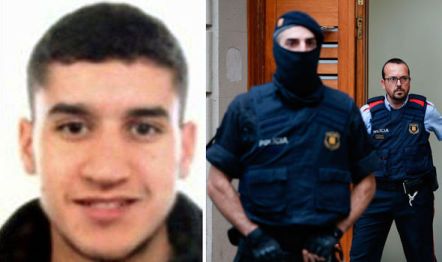
The Spanish police have now confirmed that the person they shot this evening in Barcelona is , the person suspected of being the van driver who drove into people in Las Ramblas on Thursday 17th August. The police were tipped off by a petrol station employee who recognised Abouyaaqoub as to his location and he was shot by the police who found him hiding in a nearby vineyard. This does not signal the end of the investigation, it is still ongoing as the Spanish police look for evidence to see if anyone else was involved in this Islamic State inspired terrorist cell. I will be discussing this tonight just after 23.10 hours (BST) on Al Jazeera.

Terrorist Attack Barcelona

Spanish Terrorist Attacks: Latest

Abouyaaqoub

Following the terrorist attacks in Barcelona and Cambrils Thursday 17th August where 14 people were killed when vehicles were driven into people, it is believed that the male, Younes Abouyaaqoub, who drove the van into the crowds in Las Ramblas, Barcelona has entered France. As a result the hunt for Abouyaaqoub has been extended to other European countries. It is suspected that Abouyaaqoub hijacked a car that was later found close the Spanish/French border abandoned with the driver, Pau Perez found stabbed to death in the vehicle.

On Wednesday 16th August 2017, there was an explosion in Ripoll killing three people injuring the only survivor of the blast,  Mohamed Chemlal. The Spanish police have linked this explosion to Thursday’s attacks.  Mohamed Chemlal is suspected to be a bomb maker and is currently under arrest being interviewed by the police. If those involved in the attacks had improvised explosive devices available to them in the attacks there is no doubting more people would have been killed.

Although Islamic State have claimed responsibility for the attacks, it is more likely that those carrying out the attacks were inspired by Islamic State rather than acting under direct orders from the group. It is suspected that Imam Es Satty was behind the radicalisation of the attackers to Islamic State’s narrative.

Australian Bomb Plot

In relation to the Australian bomb plot where it was planned for an improvised explosive device (IED) to be taken into the cabin area of an Etihad Airways flight from Sydney to the UAE that was foiled by the Australian Federal Police (AFP) on the 15th July 2017, the Lebanese Interior Minister has revealed that four Lebanese-Australians are allegedly behind the plan, with one being held in Lebanon and two in Australia. Again Islamic State are believed to be behind the plot as the AFP revealed a senior member of Islamic State gave the suspects instructions to carry out the attack along with parts for the IED being sent to the suspects via international cargo form Turkey along with instructions on how to build the bomb. The hearing for the two suspects in Australia has been adjourned to the 14th November.

Iraq army makes advances on Tal Afar as Islamic State lose control of More territory

tal afar

The Iraqi Army says it has taken a number of villages on the outskirts of the northern Iraqi city of Tal Afar from Islamic State control. Tal Afar is the only major city Islamic sate still control in Iraq and this action is part of the Iraqi Army’s plan to liberate the city. Tal Afar has a large population of Yazidis, who following Islamic state’s pogrom against the in 2-014/15, it is believed those Yazidis who survived are Islamic Sate slaves. As such the Iraqi Army are being encouraged to liberate the city as soon as possible.